
Resin-bound driveways for Round Rock, engineered for Texas clay and sun
Real stone, bound in UV-stable resin, troweled seamless and permeable. No cracks to chase like concrete, no joints to settle like pavers. Built on an engineered base for Blackland clay, installed by the owner, warrantied in writing.
- Vuba-Certified Installer
- $2M GL + Workers' Comp Insured
- Round Rock Registered Contractor
- 5-Year Workmanship Warranty
- Manufacturer-Backed Resin Warranty
Real stone, not a concrete costume
From twenty feet, stamped concrete and resin-bound aggregate can look similar. Up close, and a few Texas summers in, they are nothing alike.
Stamped concrete is concrete. A slab, poured and pressed with a rubber mat to fake the look of stone, then sealed and colored. It is still rigid concrete sitting on Blackland clay, which means it still cracks, the color still fades, and the fake-stone pattern gives it away the moment you stand on it. It is a costume.
Pavers are real, and they start beautifully. The problem is what happens to the gaps. Every paver driveway is hundreds of small units set in sand with joints between them. The sand washes out in heavy rain. The joints settle unevenly as the clay moves underneath. Weeds find the gaps. Within a few years you are re-sanding, re-leveling, and pulling growth out of the seams, and the surface that looked seamless on day one reads as a grid of shifting blocks.
Resin-bound aggregate is the genuine article. Real stone, washed and graded, bound in a clear UV-stable resin and troweled into one continuous surface. No fake texture stamped into a slab. No joints to settle. No sand to refill. No weeds coming up through gaps, because there are no gaps. It is the look people are reaching for when they choose stamped concrete or pavers, delivered with the actual material and without the failure mode that comes with each of the alternatives.
That is the case for how it looks. The reason it survives central Texas is what is underneath it and what it is made of.
What resin-bound aggregate actually is
A resin-bound surface is two things working together: the stone you see and the resin you do not.
The stone is natural aggregate, washed, dried, and graded to a consistent size, in blends that read as warm Hill Country stone (honeyed limestone, weathered sand, warm grey). On a working day, the dry aggregate and the resin are blended in a forced-action mixer in measured batches, then troweled out by hand across a prepared base and worked to a smooth, level finish. As the resin cures, it locks every stone to its neighbors and to the base below, producing one seamless permeable surface with no lines, no grout, and no sand.
Because the surface is bound rather than poured solid, it stays flexible. Water passes straight through the gaps between the bound stones and drains into the engineered base, rather than sheeting off the top. That single property (permeability) is what makes resin-bound behave so differently from concrete in a climate that swings from drought to flash flood and back.
Engineered for central Texas.
Built for Blackland clay
Central Texas sits on Blackland clay, a Vertisol soil that swells up to thirty percent when it rains and shrinks back when it dries. That movement is what cracks driveways. A rigid concrete slab cannot flex with the ground, so it fractures, tilts, and drops unevenly, with one section sitting an inch or two below the next. We do not fight the clay with a stiffer slab. We build a base that works with the movement: a lime-stabilized subgrade to calm the clay, then a 4 to 6 inch open-graded base that carries the load and drains. The resin-bound surface on top is flexible, so as the ground breathes through the seasons, the surface moves with it instead of cracking against it. When we resurface over an existing concrete driveway, the same logic applies: the slab has to be structurally sound first, or its cracks will eventually show through, which is why we assess it before we commit to that approach.
UV-stable aliphatic resin that holds its color
A Round Rock driveway takes Phoenix-class summer sun and 100-degree-plus surface temperatures for months. The resin is what decides whether the surface holds up or degrades. There are two kinds. Aromatic resin is cheaper and yellows quickly under UV. Aliphatic resin is UV-stable and engineered to hold its color and integrity at surface temperatures well above ambient. We install aliphatic, every time, and we will show you the product data. This is the single most common corner cut in resin-bound, and it is the difference between a surface that still looks right in year fifteen and one that has gone yellow and soft.
Permeable drainage for Flash Flood Alley
Austin and Round Rock sit in what is genuinely called Flash Flood Alley, the part of North America that produces the most flash flooding per square mile, with peak seasons in spring and fall. A resin-bound driveway drains over 600 litres per square metre per minute straight through the surface into the base below, so rain soaks in on your property instead of sheeting across it and adding to the runoff into the street and storm system. For a homeowner that means no standing water and no sheet of runoff carrying grit across the drive. It can also matter for impervious-cover rules, which some Williamson County jurisdictions enforce on how much of a lot can be hard, sealed surface. A permeable surface is treated differently from a sealed slab. We verify that for your specific property and city. We do not promise it blindly, because the rulebooks differ.
A flexible composite that handles hail
Round Rock and Georgetown took 1.5 to 2 inch hail in 2025, and large hail is a recurring central Texas event. A resin-bound surface is a flexible stone-and-resin composite, which absorbs impact far better than concrete pits or pavers chip. We will be straight with you about the limit: very large hail can leave minor surface pitting, and we are not going to claim it is hail-proof. But where a rigid slab cracks and a paver shatters, the bound composite flexes and recovers. After a hailstorm, your roof and your cars are the claim. The driveway is usually fine.
Scoped to your property — not a per-square-foot guess.
We don't publish a per-square-foot number, and we don't send email quotes from a photo. Every estimate starts with an hour on your property, with the owner, looking at the actual sub-base, drainage, edges, and access.
You receive a written, line-itemed scope in your inbox within 48 business hours. It tells you exactly what we'll install, how we'll prep the base, which Vuba aggregate blend we're proposing, and what the warranty covers. No ranges. No upsells on site.
If the job isn't a good fit for resin-bound — failing slab, no drainage path, an HOA we know will reject the system — we'll tell you that on the walk and refer you elsewhere.
Response within 4 business hours. Site visits are free and never obligation-bundled.
Four steps. Owner on every one.
- 01We walk your property
About an hour, no charge. Terry, not a commissioned closer.
- 02You get a scoped estimate
Written and itemized within 48 hours of the visit.
- 03We handle approvals
HOA architectural review and city permit, both managed by us. Install is scheduled only after written approval.
- 04We install
Three to five days for a typical driveway. A vetted crew on site, working to the written spec, with Terry running the schedule.
Also see our other resin-bound surfaces: resin-bound patios and resin-bound pool decks.
Three warranties. All in writing.
Manufacturer-backed resin warranty
Vuba's manufacturer warranty on the UV-stable aliphatic resin system itself, covering the material that makes the surface what it is. The written warranty terms are handed to you at walk-through.
5-year workmanship warranty
Our warranty on the installation: the base, the mix, the trowel finish, the edges. If our work fails, we come back and fix it.
Sub-base settlement
The engineered base (lime-stabilized subgrade plus open-graded base) is built to carry the load and move with the clay. We stand behind the way we build it, and the warranty letter spells out what is covered and the maintenance that keeps it valid.
We handle the HOA submission
Most Round Rock master-planned communities (Forest Creek, Behrens Ranch, Walsh Ranch, Teravista, and the rest) control exterior changes through an architectural review committee, and changing your driveway surface needs their written approval before any work starts. Resin-bound is new enough in this market that most committees have never reviewed it, which is exactly why how the submission is written matters. We handle it. We write the ARC submission, supply physical stone samples for the committee to see and hold, document the material and the install method, and answer the questions that come back. We schedule the install only after the approval is in writing, never before, so you are never paying for work the committee can object to after the fact. Plan for roughly two to four weeks for approval, depending on how often your committee meets.
Selected installations.


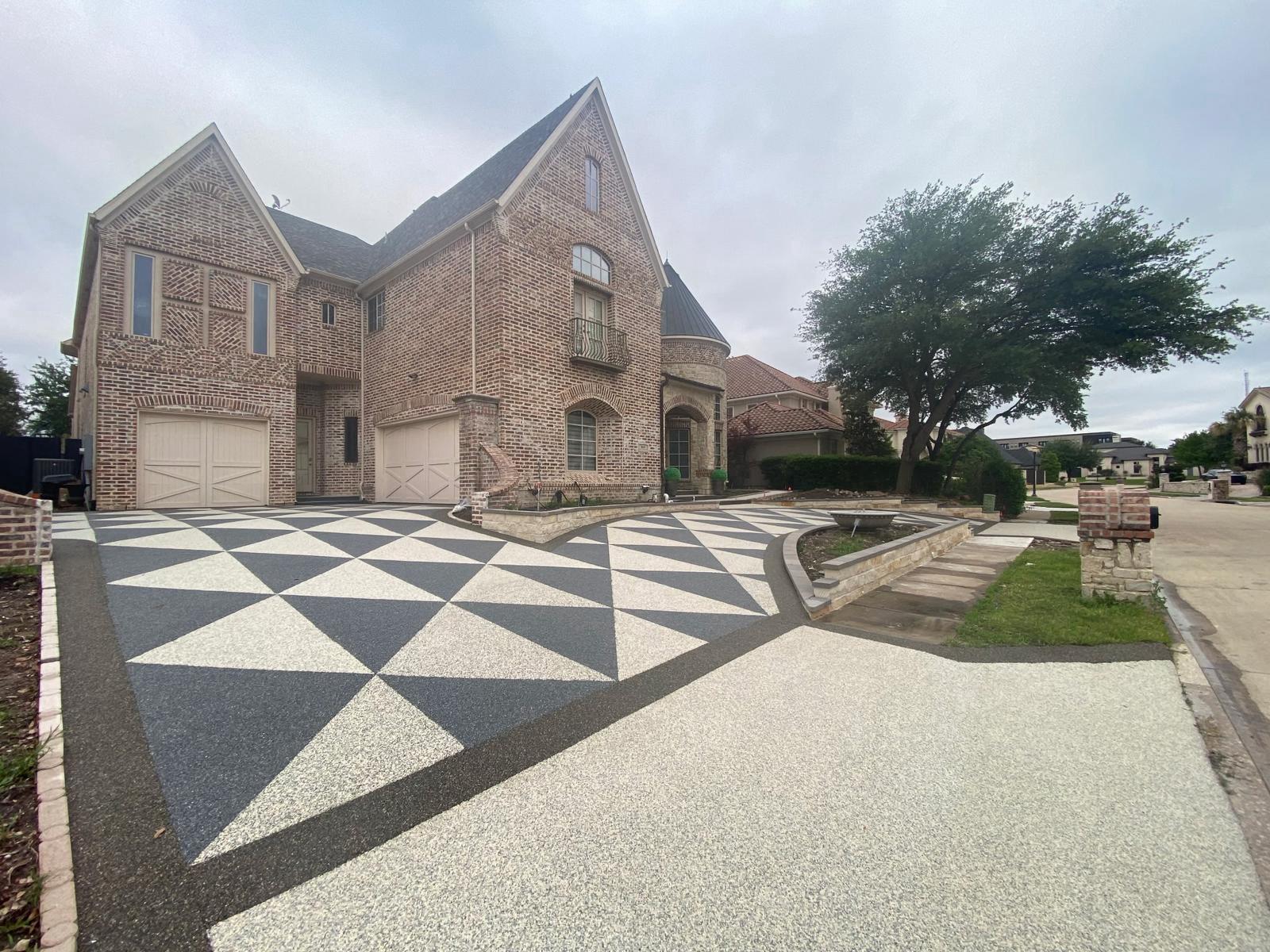
Photography: Vuba reference installations from the certified installer network. Our Round Rock portfolio is added here as local installs complete.
Common questions.
Ready to scope your project?
We answer the phone Monday through Saturday, 8am to 6pm CT.